









SparkFun Thing Plus - RP2350
Description
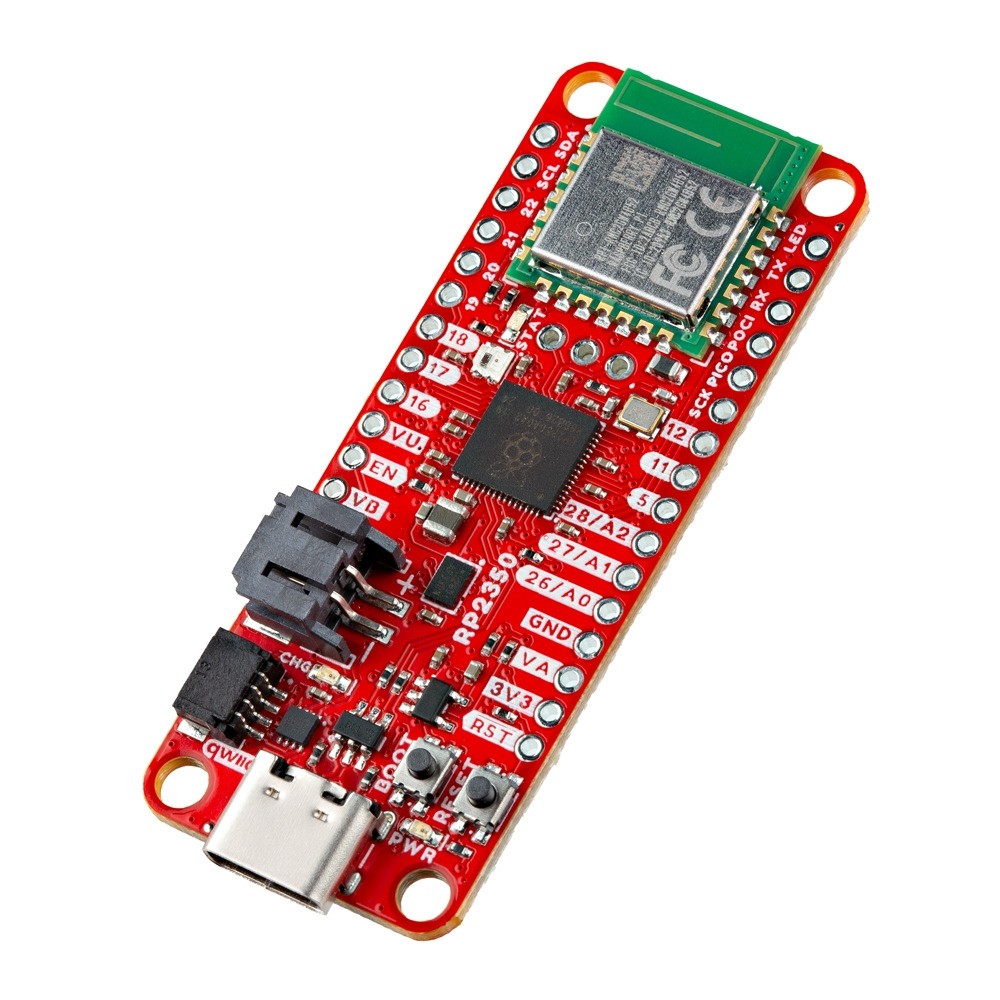
The RP2350 microcontroller offers a dual-core, dual-architecture setup, running up to 150MHz. You can choose between a pair of Arm® Cortex-M33 cores, a pair of Hazard3 RISC-V cores, or one of each, providing flexibility in development. The board is equipped with 520kB of SRAM, two UARTs, two SPI controllers, two I2C controllers, and a USB 1.1 controller for versatile connectivity options.
For IoT functionality, the board integrates the Raspberry Pi RM2 Radio Module, offering 2.4GHz WiFi 4 and Bluetooth® 5.2. This ensures a reliable connection for network applications. The board features 16MB of external Flash and 8MB of PSRAM, providing ample storage for complex applications and large data buffers.
Built in the SparkFun Thing Plus form factor, it is compatible with the Adafruit Feather footprint. It offers 21 GPIO pins, PTH connections for USB voltage (5V), regulated 3.3V, battery voltage, the RP2350 reset signal, and the voltage regulator Enable pin, all on standard 2.54mm spaced headers.
To simplify usage, the board includes a Qwiic connector, allowing easy integration with the SparkFun Qwiic ecosystem of sensors, displays, and actuators. A micro-SD card slot adds massive data-logging capabilities or storage for configuration files. Power management is streamlined with a USB-C connector and a 2-pin JST connector for a LiPo battery, complemented by an onboard MCP73831 charger and MAX17048 fuel gauge, making remote deployment straightforward.
Visual feedback is enhanced with an addressable WS2812 RGB LED and dedicated power, charge, and status LEDs. The RP2350 Thing Plus supports C/C++ via the Raspberry Pi Pico SDK, MicroPython, CircuitPython, and the Arduino environment, giving developers the flexibility to choose their preferred programming language and environment.
Properties
Delivered in 5 to 7 days
 SparkFun Thing Plus - RP2350 Delivered in 5 to 7 days € 47,40
 Customer questions
Customer Reviews
- Reduced In stock -49 % Sparkfun LED - Ultraviolet € 2,15 € 1,10 View product
- Reduced In stock -50 % Sparkfun Diffused LED - Yellow 10mm € 1,10 € 0,55 View product
- Reduced In stock -50 % Sparkfun Screw Terminals 5mm Pitch (2-Pin) € 1,60 € 0,80 View product
- Reduced In stock -50 % Sparkfun 555 Timer € 1,50 € 0,75 View product
- Reduced In stock -50 % Sparkfun Battery Holder 2xAA with Cover and Switch € 2,50 € 1,25 View product
- Reduced In stock -50 % Sparkfun Diode Rectifier - 1A, 50V (1N4001) € 0,40 € 0,20 View product
- Reduced In stock -49 % Sparkfun Rocker Switch - SPST (right-angle) € 3,95 € 2,- View product
- Reduced In stock -50 % Sparkfun Solder Leaded - 15-gram Tube € 5,65 € 2,85 View product
- Reduced In stock -50 % Sparkfun Coin Cell Battery Holder - 20mm (PTH) € 2,50 € 1,25 View product
- Reduced In stock -49 % Sparkfun Reed Switch € 3,25 € 1,65 View product
- Reduced In stock -50 % Sparkfun Flexible Qwiic Cable - Breadboard Jumper (4-pin) € 3,60 € 1,80 View product
- Reduced In stock -48 % Sparkfun Screw Terminals 5mm Pitch (3-Pin) € 1,65 € 0,85 View product
- Reduced In stock -50 % Sparkfun Barrel Jack Power Switch - M-F (3") € 5,- € 2,50 View product
- Reduced In stock -50 % Sparkfun Female Headers € 2,80 € 1,40 View product
- Reduced In stock -50 % SparkFun Voltage-Level Translator Breakout - TXB0104 € 8,50 € 4,25 View product
Recently viewed items