









Sparkfun SparkPNT GNSS Flex Module - ZED-X20P & IM19 IMU
Description
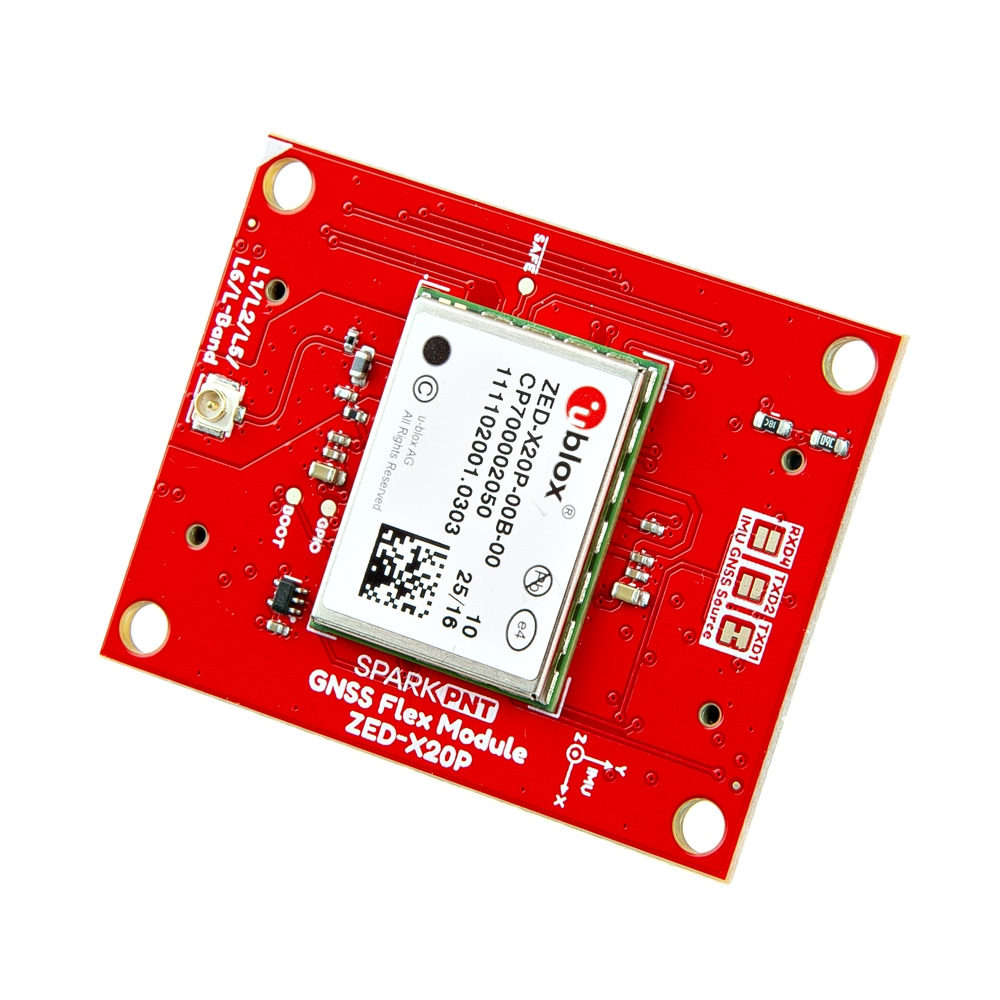
This module is perfect for applications requiring precise control, such as UAVs, guidance systems, and auto-steering. The u-blox ZED-X20P-01B core provides centimeter-level accuracy by processing signals from all major constellations, including GPS, Galileo, and BeiDou, across all frequency bands. It supports Real-time Kinematics (RTK), PPP-RTK, Galileo HAS, and Precise Point Positioning for flexibility. Additionally, it natively supports L-band correction services, eliminating the need for external receivers.
With high update rates, the module ensures smooth operation in high-speed robotics and vehicle control systems. It also features multi-layered security defenses, including a Root of Trust, advanced jamming and spoofing detection, and Galileo OSNMA cryptographic authentication.
The IM19 IMU pairs with the ZED-X20P to provide high-precision attitude measurements through MEMS sensor data and GNSS RTK positioning. This allows for tilt-compensated surveying and robust navigation during brief GNSS outages. It delivers survey-grade accuracy with roll and pitch measurements accurate to within 0.05 degrees. The tilt compensation feature revolutionizes field data collection by calculating a virtual digital level point at any tilt angle. Sensor fusion enables continuous navigation, or dead reckoning, even during GNSS signal loss, making it ideal for urban or obstructed environments.
The GNSS Flex Module is designed for seamless integration and connectivity. By default, the ZED-X20P's navigation data is automatically fed to the IMU, which outputs proprietary NMEA messages containing the fully compensated position and attitude. This default link can be easily reconfigured via onboard jumpers to suit specific project needs.
For optimal performance, an external antenna and a GNSS Flex carrier board are required. Users have two options for connecting an external GNSS antenna: a U.FL connector on the module or a sturdier SMA connector on a GNSS Flex pHAT carrier board. A short U.FL cable can be used to connect the module and the carrier board.
Properties

Delivered in 5 to 7 days
 Sparkfun SparkPNT GNSS Flex Module - ZED-X20P & IM19 IMU Delivered in 5 to 7 days € 619,45
 Customer questions
Customer Reviews
- Reduced In stock -49 % Sparkfun LED - Ultraviolet € 2,15 € 1,10 View product
- Reduced In stock -50 % Sparkfun Diffused LED - Yellow 10mm € 1,10 € 0,55 View product
- Reduced In stock -50 % Sparkfun Screw Terminals 5mm Pitch (2-Pin) € 1,60 € 0,80 View product
- Reduced In stock -50 % Sparkfun 555 Timer € 1,50 € 0,75 View product
- Reduced In stock -50 % Sparkfun Battery Holder 2xAA with Cover and Switch € 2,50 € 1,25 View product
- Reduced In stock -50 % Sparkfun Diode Rectifier - 1A, 50V (1N4001) € 0,40 € 0,20 View product
- Reduced In stock -49 % Sparkfun Rocker Switch - SPST (right-angle) € 3,95 € 2,- View product
- Reduced In stock -50 % Sparkfun Solder Leaded - 15-gram Tube € 5,65 € 2,85 View product
- Reduced In stock -50 % Sparkfun Coin Cell Battery Holder - 20mm (PTH) € 2,50 € 1,25 View product
- Reduced In stock -49 % Sparkfun Reed Switch € 3,25 € 1,65 View product
- Reduced In stock -50 % Sparkfun Flexible Qwiic Cable - Breadboard Jumper (4-pin) € 3,60 € 1,80 View product
- Reduced In stock -48 % Sparkfun Screw Terminals 5mm Pitch (3-Pin) € 1,65 € 0,85 View product
- Reduced In stock -50 % Sparkfun Barrel Jack Power Switch - M-F (3") € 5,- € 2,50 View product
- Reduced In stock -50 % Sparkfun Female Headers € 2,80 € 1,40 View product
- Reduced In stock -50 % SparkFun Voltage-Level Translator Breakout - TXB0104 € 8,50 € 4,25 View product
Recently viewed items