









SparkFun GNSS Flex pHAT - LG290P
Description
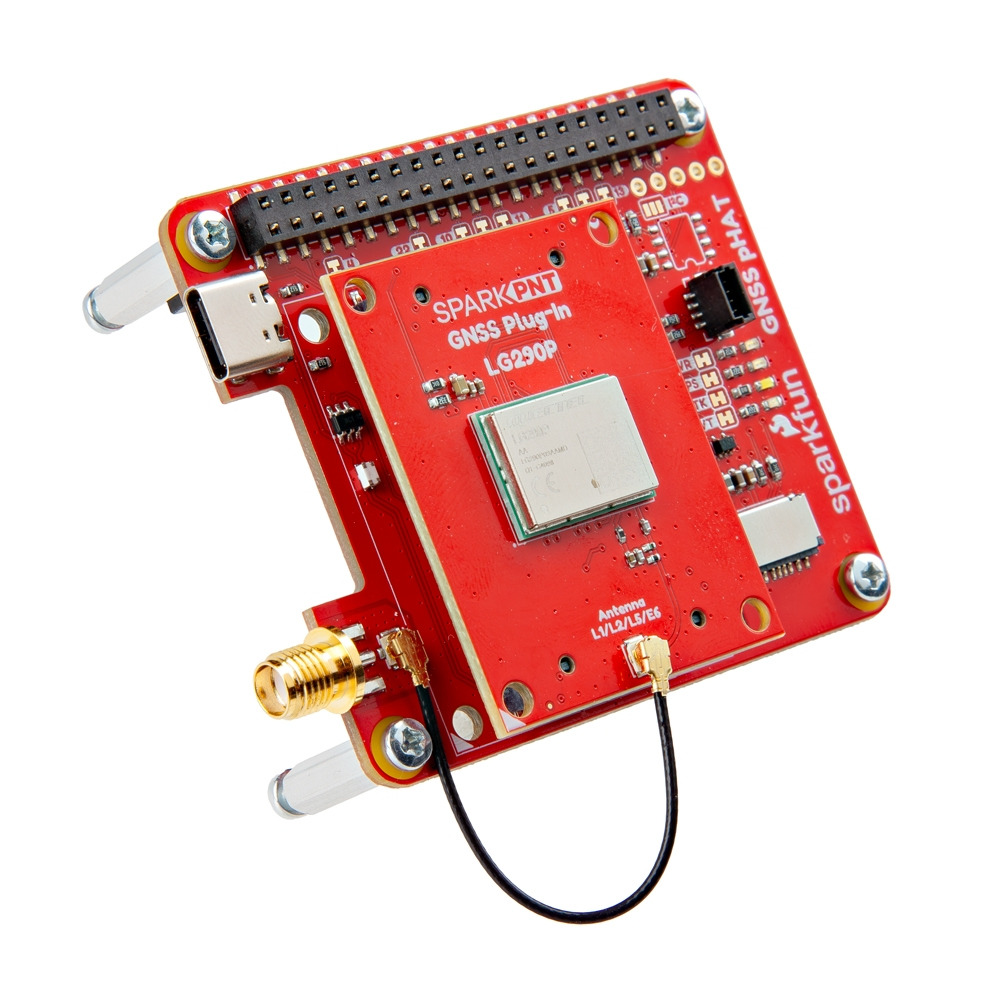
The versatility of this board shines in its ability to support multiple single-board computers, allowing users to easily integrate it into existing projects. This makes it an excellent choice for developers working on applications that require precise positioning, such as autonomous vehicles, drone navigation, or geographic information systems (GIS).
One of the standout features is its robust quad-band RTK capability, enabling it to receive signals from L1, L2, L5, and L6/E6 bands across all major constellations. This ensures reliable performance in environments with signal challenges, such as urban canyons or dense forests. The built-in NIC anti-jamming unit further enhances signal integrity by detecting and mitigating interference.
The board supports standard RTK/RTCM corrections, a variety of SBAS augmentation systems, and PPP services, although some features are still under development. Users can connect an external GNSS antenna via the U.FL connector or a more secure SMA connector, ensuring flexibility in setup.
While the primary interface is through the Raspberry Pi's serial bus, users have the option to utilize other interfaces, offering flexibility in how the GNSS receiver communicates with the host computer. This flexibility, combined with the board's high-precision capabilities, makes it a valuable tool for projects that demand exact positioning.
Properties
Delivered in 5 to 7 days
 SparkFun GNSS Flex pHAT - LG290P Delivered in 5 to 7 days € 183,85
 Customer questions
Customer Reviews
- Reduced In stock -49 % Sparkfun LED - Ultraviolet € 2,15 € 1,10 View product
- Reduced In stock -50 % Sparkfun Diffused LED - Yellow 10mm € 1,10 € 0,55 View product
- Reduced In stock -50 % Sparkfun Screw Terminals 5mm Pitch (2-Pin) € 1,60 € 0,80 View product
- Reduced In stock -50 % Sparkfun 555 Timer € 1,50 € 0,75 View product
- Reduced In stock -50 % Sparkfun Battery Holder 2xAA with Cover and Switch € 2,50 € 1,25 View product
- Reduced In stock -50 % Sparkfun Diode Rectifier - 1A, 50V (1N4001) € 0,40 € 0,20 View product
- Reduced In stock -49 % Sparkfun Rocker Switch - SPST (right-angle) € 3,95 € 2,- View product
- Reduced In stock -50 % Sparkfun Solder Leaded - 15-gram Tube € 5,65 € 2,85 View product
- Reduced In stock -50 % Sparkfun Coin Cell Battery Holder - 20mm (PTH) € 2,50 € 1,25 View product
- Reduced In stock -49 % Sparkfun Reed Switch € 3,25 € 1,65 View product
- Reduced In stock -50 % Sparkfun Flexible Qwiic Cable - Breadboard Jumper (4-pin) € 3,60 € 1,80 View product
- Reduced In stock -48 % Sparkfun Screw Terminals 5mm Pitch (3-Pin) € 1,65 € 0,85 View product
- Reduced In stock -50 % Sparkfun Barrel Jack Power Switch - M-F (3") € 5,- € 2,50 View product
- Reduced In stock -50 % Sparkfun Female Headers € 2,80 € 1,40 View product
- Reduced In stock -50 % SparkFun Voltage-Level Translator Breakout - TXB0104 € 8,50 € 4,25 View product
Recently viewed items