









Sparkfun Raspberry Pi 3 A+
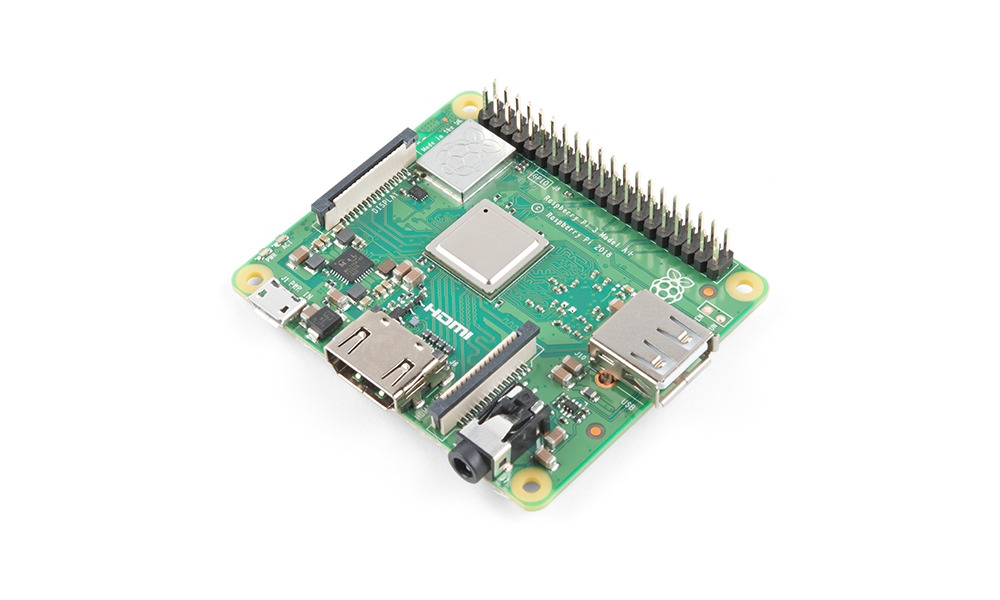
Description
The Raspberry Pi 3 A+ is perfect for educational purposes, especially in teaching programming to kids worldwide. Its ability to run multiple Linux distributions makes it a flexible tool for learning and experimenting. Despite its small size, it packs the power needed for a range of applications, from simple projects to more complex computing tasks.
For those interested in hardware projects, the Raspberry Pi 3 A+ offers a 40-pin GPIO header with 2.54mm spacing, providing access to 27 GPIO, UART, I2C, SPI, and both 3.3V and 5V power sources. This makes it an excellent choice for hardware hacking and DIY electronics projects. Each pin is consistent with previous models, ensuring compatibility with existing HATs and peripherals.
Powering the Raspberry Pi 3 A+ is straightforward. Simply connect a 5V/2.5A USB power supply to the microUSB port to get it running. With no power button, it boots up automatically when power is applied, and shutting it down is as easy as removing the power after a proper shutdown.
For expanded connectivity, consider using a powered USB hub to connect additional peripherals like a mouse or keyboard, ensuring the onboard voltage regulator is not overloaded. This setup allows you to maximize the potential of this compact yet powerful computing platform.
Properties
Delivered in 5 to 7 days
 Sparkfun Raspberry Pi 3 A+ Delivered in 5 to 7 days € 42,35
 Customer questions
Customer Reviews
- Reduced In stock -49 % Sparkfun LED - Ultraviolet € 2,15 € 1,10 View product
- Reduced In stock -50 % Sparkfun Diffused LED - Yellow 10mm € 1,10 € 0,55 View product
- Reduced In stock -50 % Sparkfun Screw Terminals 5mm Pitch (2-Pin) € 1,60 € 0,80 View product
- Reduced In stock -50 % Sparkfun 555 Timer € 1,50 € 0,75 View product
- Reduced In stock -50 % Sparkfun Battery Holder 2xAA with Cover and Switch € 2,50 € 1,25 View product
- Reduced In stock -50 % Sparkfun Diode Rectifier - 1A, 50V (1N4001) € 0,40 € 0,20 View product
- Deal In stock -58 % Sparkfun Rocker Switch - SPST (right-angle) € 3,95 € 1,65 View product
- Reduced In stock -50 % Sparkfun Solder Leaded - 15-gram Tube € 5,65 € 2,85 View product
- Reduced In stock -50 % Sparkfun Coin Cell Battery Holder - 20mm (PTH) € 2,50 € 1,25 View product
- Reduced In stock -49 % Sparkfun Reed Switch € 3,25 € 1,65 View product
- Reduced In stock -50 % Sparkfun Flexible Qwiic Cable - Breadboard Jumper (4-pin) € 3,60 € 1,80 View product
- Reduced In stock -48 % Sparkfun Screw Terminals 5mm Pitch (3-Pin) € 1,65 € 0,85 View product
- Reduced In stock -50 % Sparkfun Barrel Jack Power Switch - M-F (3") € 5,- € 2,50 View product
- Reduced In stock -50 % Sparkfun Female Headers € 2,80 € 1,40 View product
- Reduced In stock -50 % SparkFun Voltage-Level Translator Breakout - TXB0104 € 8,50 € 4,25 View product
Recently viewed items