









Sparkfun Digi X-ON Kit for LoRaWAN® (North America)
Description
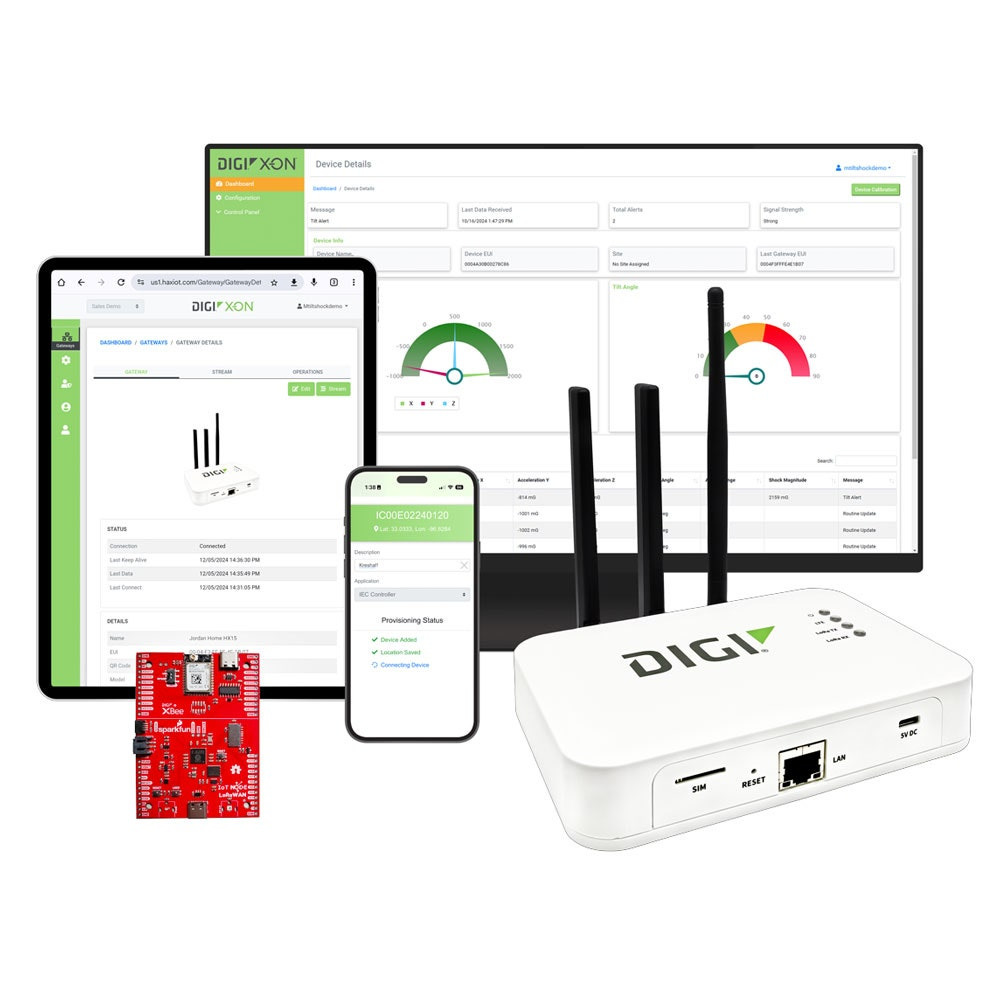
Effortlessly create and deploy a LoRaWAN® IoT sensor in minutes. Set up the Digi HX15 Gateway, register the IoT Node, attach an antenna and a Qwiic sensor, and power the board. The pre-installed firmware automatically connects to Digi X-ON, detects sensors, and posts data to the cloud. Customize and develop software with ease using the IoT Node for LoRaWAN® board.
Firmware development is primarily conducted in the Arduino environment, facilitated by the Arduino XBee® library from Digi. The combination of Digi's library and SparkFun's extensive range of Qwiic sensors opens up endless possibilities for creating LoRaWAN® IoT sensors. The open-source application allows for rapid customization.
At the core of the IoT Node for LoRaWAN® board is the RP2350 microprocessor from Raspberry Pi, compatible with various development environments like Arduino, micropython, and the Raspberry Pi pico SDK. The board is equipped with 16 MB of flash, 8 MB PSRAM, a Qwiic connector, on-board LiPo battery charging, fuel gauge circuits, a microSD card slot, various IO pins, an RGB LED, and a user button.
The Digi XBee® LR module for LoRaWAN® is directly connected to the RP2350's serial port, offering direct control and access via a development library. This module provides exceptional operational performance and ease of onboarding, utilizing LoRa™ modulation for long-range, high-noise RF environments. Each module is pre-activated on Digi's X-ON cloud platform, ensuring seamless connection and management.
Properties

Delivered in 5 to 7 days
 Sparkfun Digi X-ON Kit for LoRaWAN® (North America) Delivered in 5 to 7 days € 583,15
 Customer questions
Customer Reviews
- Reduced In stock -49 % Sparkfun LED - Ultraviolet € 2,15 € 1,10 View product
- Reduced In stock -50 % Sparkfun Diffused LED - Yellow 10mm € 1,10 € 0,55 View product
- Reduced In stock -50 % Sparkfun Screw Terminals 5mm Pitch (2-Pin) € 1,60 € 0,80 View product
- Reduced In stock -50 % Sparkfun 555 Timer € 1,50 € 0,75 View product
- Reduced In stock -50 % Sparkfun Battery Holder 2xAA with Cover and Switch € 2,50 € 1,25 View product
- Reduced In stock -50 % Sparkfun Diode Rectifier - 1A, 50V (1N4001) € 0,40 € 0,20 View product
- Reduced In stock -49 % Sparkfun Rocker Switch - SPST (right-angle) € 3,95 € 2,- View product
- Reduced In stock -50 % Sparkfun Solder Leaded - 15-gram Tube € 5,65 € 2,85 View product
- Reduced In stock -50 % Sparkfun Coin Cell Battery Holder - 20mm (PTH) € 2,50 € 1,25 View product
- Reduced In stock -49 % Sparkfun Reed Switch € 3,25 € 1,65 View product
- Reduced In stock -48 % Sparkfun Screw Terminals 5mm Pitch (3-Pin) € 1,65 € 0,85 View product
- Reduced In stock -50 % Sparkfun Barrel Jack Power Switch - M-F (3") € 5,- € 2,50 View product
- Reduced In stock -50 % Sparkfun Female Headers € 2,80 € 1,40 View product
- Reduced In stock -50 % SparkFun Voltage-Level Translator Breakout - TXB0104 € 8,55 € 4,25 View product
- Reduced In stock -50 % Sparkfun Force Sensitive Resistor 0.5" € 15,65 € 7,85 View product
Recently viewed items