









Sparkfun Experiential Robotics Platform (XRP) - DIY Kit
Description
The XRP kit is ideal for educational settings and enthusiasts looking to delve into robotics. Its tool-free construction and compatibility with 3D-printed components make it a perfect choice for classrooms and workshops. The inclusion of a Raspberry Pi® RP2350B dual-core processor, along with a low-power accelerometer and gyroscope, allows for sophisticated projects and experiments. The platform supports various sensors and accessories, thanks to its Qwiic® connectors, enabling users to expand their robot’s capabilities seamlessly.
One of the standout features of this kit is its adaptability. Without a pre-included chassis, users are encouraged to design and print their own, fostering creativity and customization. The snap-fit components and optimized 3D-printing compatibility ensure that assembly is straightforward and accessible, even for beginners. This flexibility not only enhances the learning experience but also allows for personalized projects, catering to individual interests and goals.
The XRP kit's programming environment supports Blockly, Python, and WPILib, catering to a wide range of skill levels. This multi-language approach ensures that both novices and experienced programmers can engage with the platform effectively. The online modules and projects provide a structured learning path, presenting challenges that reinforce robotics concepts and encourage critical thinking.
For educators and FIRST teams, the XRP kit is available at a discounted rate, making it an affordable option for integrating robotics into the curriculum. This commitment to education underscores the platform's aim to nurture the next generation of engineers and innovators.
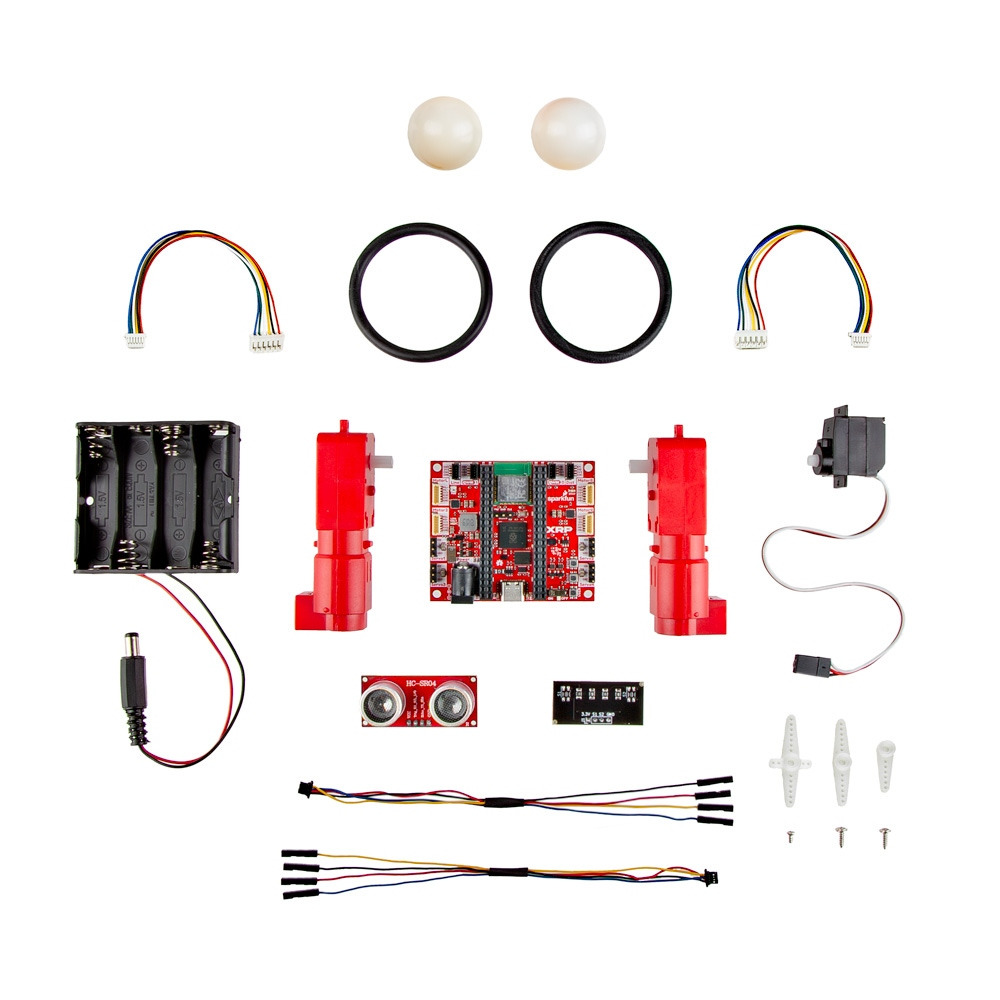
The kit includes an ultrasonic distance sensor, a line sensor, two motors with encoders, a servo motor, sensor cables, two wheels, and two casters. These components, along with the redesigned battery holder and versatile mounting options, contribute to the kit's durability and user-friendliness. The XRP can be powered by 4xAA batteries or any supply up to 11V via a barrel connector, and programming is facilitated through a USB-C connector.
All resources for the XRP project, including hardware information, programming tools, and community support, are available online. Users can find assembly guides, 3D-printable designs, and ideas for advanced projects, making it easy to get started and continue exploring the possibilities of robotics.
Properties
Delivered in 5 to 7 days
 Sparkfun Experiential Robotics Platform (XRP) - DIY Kit Delivered in 5 to 7 days € 147,55
 Customer questions
Customer Reviews
- Reduced In stock -49 % Sparkfun LED - Ultraviolet € 2,15 € 1,10 View product
- Reduced In stock -50 % Sparkfun Diffused LED - Yellow 10mm € 1,10 € 0,55 View product
- Reduced In stock -50 % Sparkfun Screw Terminals 5mm Pitch (2-Pin) € 1,60 € 0,80 View product
- Reduced In stock -50 % Sparkfun 555 Timer € 1,50 € 0,75 View product
- Reduced In stock -51 % Sparkfun Battery Holder 2xAA with Cover and Switch € 2,55 € 1,25 View product
- Reduced In stock -50 % Sparkfun Diode Rectifier - 1A, 50V (1N4001) € 0,40 € 0,20 View product
- Reduced In stock -50 % Sparkfun Solder Leaded - 15-gram Tube € 5,65 € 2,85 View product
- Reduced In stock -49 % Sparkfun Rocker Switch - SPST (right-angle) € 3,95 € 2,- View product
- Reduced In stock -49 % Sparkfun Reed Switch € 3,25 € 1,65 View product
- Deal In stock -73 % Sparkfun Screw Terminals 5mm Pitch (3-Pin) € 1,65 € 0,45 View product
- Reduced In stock -50 % Sparkfun Barrel Jack Power Switch - M-F (3") € 5,05 € 2,55 View product
- Reduced In stock -50 % Sparkfun Female Headers € 2,80 € 1,40 View product
- Reduced In stock -50 % SparkFun Voltage-Level Translator Breakout - TXB0104 € 8,55 € 4,30 View product
- Reduced In stock -51 % Sparkfun Coin Cell Battery Holder - 20mm (PTH) € 2,55 € 1,25 View product
- Reduced In stock -50 % Sparkfun Force Sensitive Resistor 0.5" € 15,70 € 7,85 View product
Recently viewed items