









SparkFun gator:bit
Description Attachments
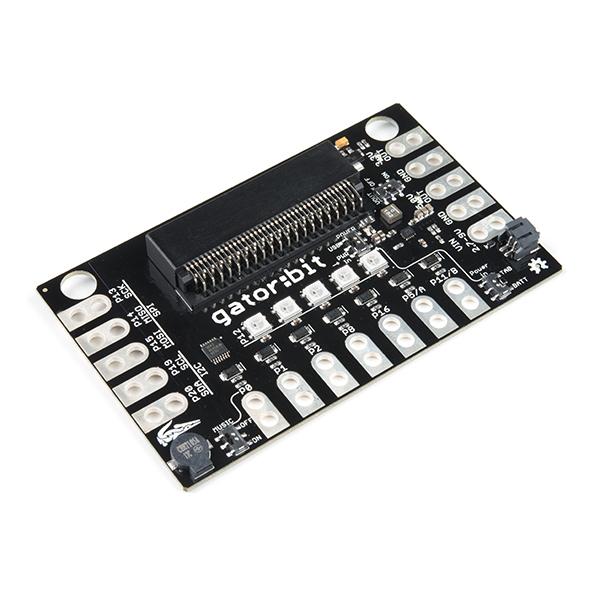
The SparkFun gator:bit provides safe access to as many GPIO as possible from the micro:bit. Pins 0, 1, 2, 8, 16, 5 (Button A), and 11 (Button B) are broken out and protected against overvoltage and overcurrent/short circuit. Pins 0, 1, and 2 are ADC pins and also function as capacitive touch pins. Pins 8, 16, 5, and 11 are digital pins, capable of read and write functions. Additionally, pins 13 (SPI), 14(SPI), 15(SPI), 19 (I2C), and 20 (I2C) can be used to read and write a variety of digital signals. More detailed information about each pin and other attributes can be found in the SparkFun gator:bit Guide.
The SparkFun gator:bit can be powered from 2.7V - 9V, offering a wide range of powering options. Power can be supplied either from the JST battery terminal or the alligator clip pads labeled “VIN”. Any voltage input between 2.7V and 9V will be regulated to 3.3V to power the micro:bit, the speaker, and any of the alligator clip pins.
Even without any external hardware, the gator:bit serves as a comprehensive development board for the micro:bit. It provides easy access for educators, beginners, and professional makers.
The micro:bit is a compact computer that lets you explore digital technology creatively. With the micro:bit and our shield-like bit boards, you can code, customize and control your micro:bit from almost anywhere! The micro:bit can be used for a multitude of unique creations, from robots to musical instruments and more. Despite being half the size of a credit card, this versatile board has enormous potential!
Note: The SparkFun gator:bit does NOT include a micro:bit board. The micro:bit will need to be purchased separately.
Features:
- micro:bit card edge connector
- Input voltage: 2.7V - 9V
- 5 built in addressable LEDs
- Integrated buzzer
- 5V output
- 3.3V output
- 7 protected input/output pins
- 3 pins for SPI communication
- 2 pins for I2C
Documents:
- Schematic
- Eagle Files
- Hookup Guide
- Getting Started with the micro:bit
- About micro:bit Page
- micro:bit Programmer
- GitHub
Properties
| Brand | Sparkfun |
| Model | DEV-14484 |
| More info | Gator:bit Hookup Guide - SparkFun Learn |
| Length | 72 mm |
| Width | 115 mm |
| Height | 12 mm |
| Weight | 91 g |

Customer questions
Customer Reviews
- In stock Sparkfun Copper Tape - Conductive Adhesive, 5mm - 15 meter € 7,65 View product
- In stock Sparkfun Thin Speaker - 4 Ohm, 2.5W, 28mm € 2,90 View product
- In stock Sparkfun Battery Holder - 2xAAA with Cover and Switch € 2,10 View product
- In stock Sparkfun Mini Power Switch - SPDT € 2,30 View product
- In stock Sparkfun Break Away Headers - 40-pin Male (Long Centered, PTH, 0.1") € 2,35 View product
- In stock Sparkfun RJ45 8-Pin Connector € 2,25 View product
- In stock Sparkfun Alligator Test Leads - Multicolored (10 Pack) € 5,90 View product
- Sale In stock -72 % Sparkfun EasyDriver - Stepper Motor Driver € 21,25 € 6,05 View product
- In stock Sparkfun USB Female Type A SMD Connector € 2,10 View product
- In stock Sparkfun MP3 Trigger € 70,55 View product
- In stock Sparkfun Hobby Motor - Gear € 3,30 View product
- In stock Sparkfun Clear Plastic Knob € 1,75 View product
- In stock Sparkfun Resistor 1K Ohm 1/4 Watt PTH - 20 pack (Thick Leads) € 2,15 View product
- In stock Sparkfun Battery Holder - 2x18650 (wire leads) € 2,65 View product
- In stock Sparkfun Hook-up Stranded Wire - Red (22 AWG) € 4,65 View product
Recently viewed items